
Myth or Fact? Understanding Form 9A and Trust-to-General Transfers in Ontario.


Disclaimer: This article provides general educational information about trust accounting practices in Ontario and is not intended as legal, accounting, or regulatory advice. Readers should consult the Law Society of Ontario and qualified professionals for guidance specific to their circumstances.
Trust accounting is one of the most important and often misunderstood aspects of legal practice management. Whether you're a lawyer, licensed paralegal, or law firm administrator in Ontario, maintaining accurate trust records isn't just good bookkeeping; it's a professional responsibility.
One question that frequently arises among legal professionals is:
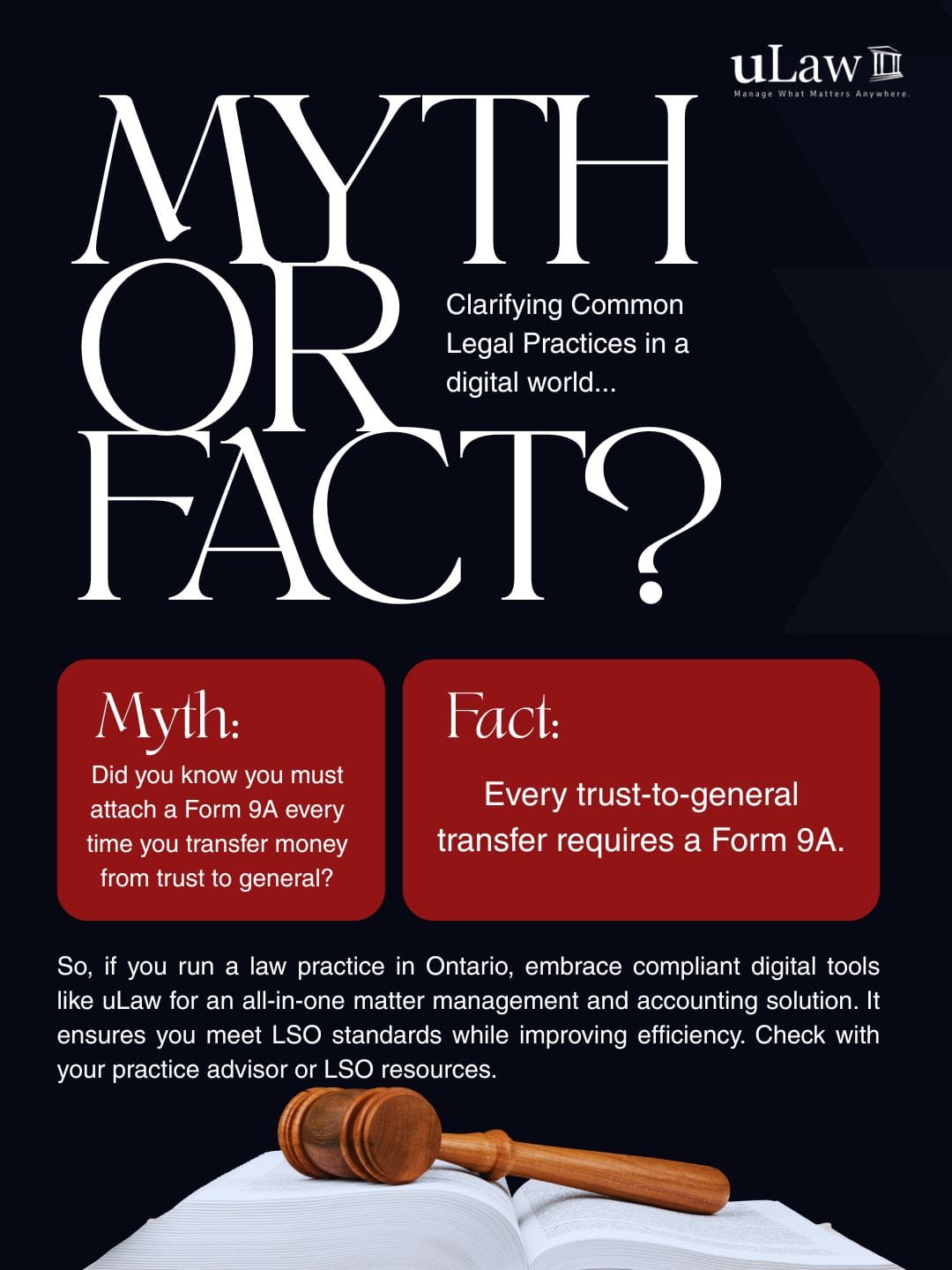
Do you need a Form 9A for every transfer from a trust account to a general account?
In Ontario, withdrawals from a trust account must be properly documented and comply with the Law Society of Ontario’s trust accounting requirements. Depending on the nature of the withdrawal, required supporting documentation may include Form 9A or other appropriate records.
Let's explore why this requirement exists and why it plays such a critical role in legal accounting.
Understanding Trust Accounts
A trust account is fundamentally different from a firm's operating or general account.
Money deposited into a trust account belongs to clients, not the law firm. These funds may include retainers, settlement proceeds, filing fees, or money held for future legal services.
Since legal professionals act as custodians of these funds, regulatory bodies such as the Law Society of Ontario (LSO) impose strict accounting standards to protect the public and maintain confidence in the legal profession.
Trust money cannot simply be transferred whenever convenient. Every movement of funds must be documented, authorized, and supported by records that clearly explain why the money is being withdrawn.
What Is Form 9A?
Form 9A serves as a written record authorizing the withdrawal of funds from a trust account.
Whenever earned legal fees or reimbursable expenses are transferred from trust to the firm's general account, Form 9A provides documentation that explains:
- which client matter the funds relate to
- the amount being withdrawn
- the purpose of the transfer
- the authorization supporting the withdrawal
- the date of the transaction
This creates a clear audit trail that can be reviewed if questions arise in the future.
Rather than being viewed as "just another form," Form 9A is an important internal control designed to ensure accountability when handling client funds.
Why Proper Documentation Matters
Legal professionals manage money that belongs to others.
For this reason, trust accounting is held to a much higher standard than ordinary business accounting.
Proper documentation helps firms:
Protect Client Funds
Accurate records reduce the risk of accidental over-withdrawals, duplicate transactions, or accounting errors.
When every withdrawal is supported by documentation, firms can quickly verify why money was moved and whether it was appropriate.
Prepare for Regulatory Reviews
The Law Society may review trust records as part of compliance activities.
Maintaining complete documentation allows firms to demonstrate that every trust transaction followed established procedures.
Well-organized records often make reviews significantly less stressful than trying to reconstruct transactions months or even years later.
Reduce Administrative Errors
Manual bookkeeping can introduce mistakes such as:
- incorrect client matter numbers
- duplicate transfers
- calculation errors
- missing invoices
- incomplete supporting records
Having consistent documentation requirements creates a standardized workflow that minimizes these risks.
Maintain Client Confidence
Clients expect transparency when their money is involved.
Being able to clearly explain every trust transaction demonstrates professionalism and reinforces confidence in the firm's financial practices.
Final Thoughts
Trust accounting is one of the foundations of professional responsibility in Ontario's legal profession. Properly documenting trust-to-general transfers including the use of Form 9A where required helps protect client funds, supports transparency, and strengthens the integrity of a firm's financial records.
Rather than viewing compliance as an administrative burden, it can be seen as an essential part of delivering ethical, professional legal services.
As legal practices continue to adopt digital workflows and modern accounting tools, maintaining accurate trust records becomes not only easier but also more consistent. Ultimately, good trust accounting isn't just about satisfying regulatory requirements, it's about protecting clients, preserving public confidence, and building a practice founded on accountability and trust.
Disclaimer: This article is intended for general informational purposes only and should not be considered legal, accounting, or regulatory advice. Trust accounting requirements may change over time. Legal professionals should consult the latest guidance published by the Law Society of Ontario (LSO) and seek professional advice where appropriate.