
Legal Billing Myths Debunked: Is Your Invoice Format Putting Your Firm at Risk?

Introduction
In the day-to-day hustle of managing client cases, court deadlines, and client communications, invoicing can often feel like an administrative task to get through as quickly as possible. For many legal practitioners, picking up a standard invoice template or relying on general small-business billing software seems like the easiest route.
However, in legal practice, an invoice is far more than a simple request for payment, it is a critical legal document subject to strict regulatory oversight.
Today, we are debunking one of the most common billing misconceptions among Canadian lawyers and paralegals: "Any invoice format works."
The Myth vs. The Reality
- The Myth: As long as the client understands the charges and payment instructions, any invoice format is acceptable.
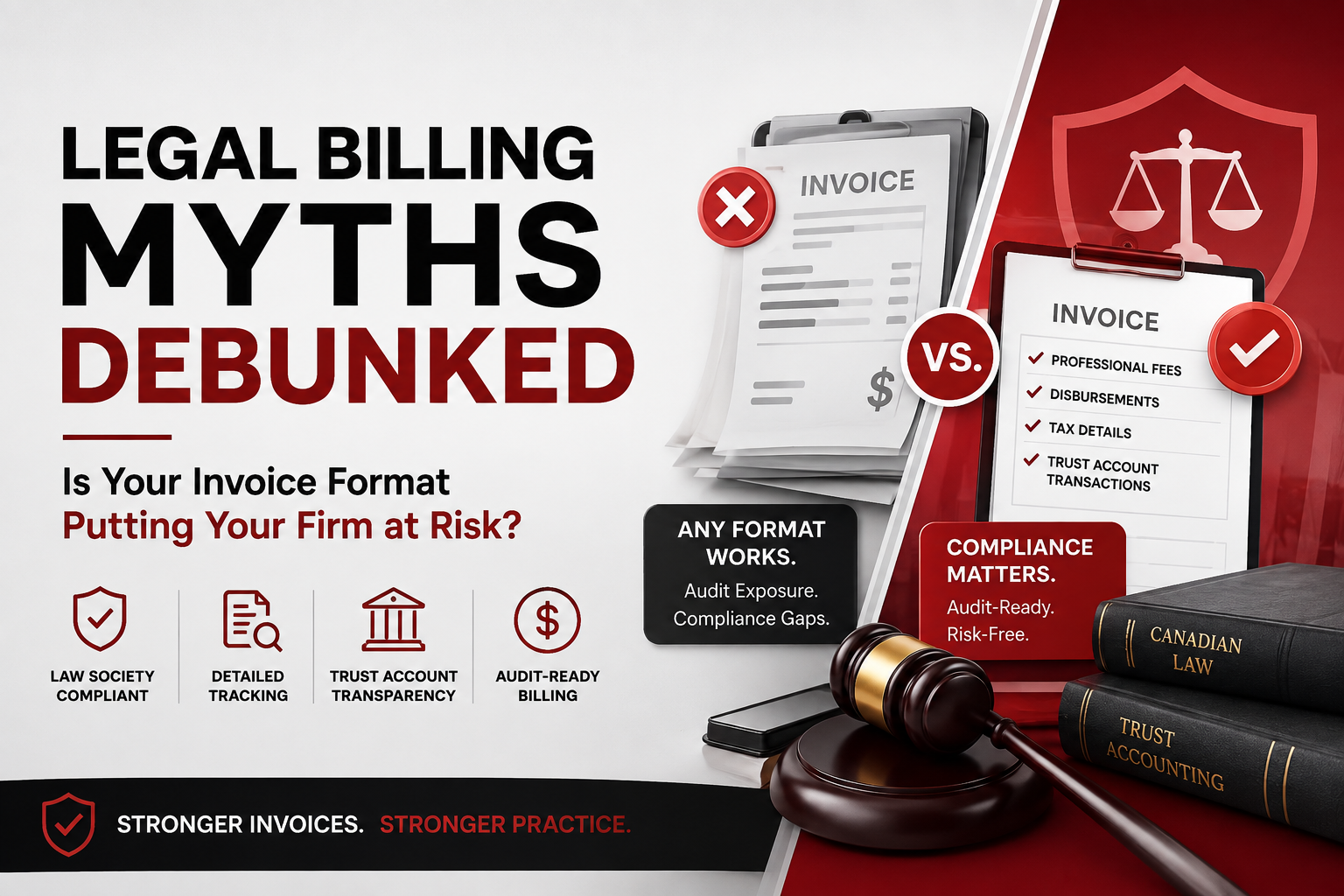
- The Fact: Law Societies across Canada require strict itemization of professional fees, disbursements, tax charges, and trust account movements on every statement of account.
Using generic billing tools often leaves out critical compliance elements, creating unnecessary exposure during Law Society practice reviews or financial audits.
What Makes an Invoice Law Society-Compliant?
Regardless of where your practice is located—whether governed by the Law Society of Ontario (LSO), the Law Society of British Columbia, the Law Society of Alberta, or other Canadian jurisdictions rules surrounding client funds and trust accounting are stringent.
A fully compliant legal invoice must provide an unambiguous audit trail. Key components include:
- Clear Trust Account Statements: If trust funds are applied to settle an invoice, the bill must explicitly detail the trust funds received, the exact amount withdrawn to cover fees/disbursements, and the remaining trust retainer balance.
- Separation of Fees and Disbursements: Disbursements incurred on behalf of the client (such as court filing fees, process servers, or land title searches) must be itemized separately from legal fees.
- Tax Transparency: Correct application and breakdown of applicable taxes (HST/GST/PST) based on the client's location and nature of service.
How Manual Invoicing Leads to Audit Stress
When legal professionals manually track trust activity across spreadsheets or separate billing platforms, key mistakes easily happen:
- Forgetting to show current trust balances on the bill.
- Miscalculating tax on disbursements versus professional services.
- Delayed entry of trust-to-general transfers.
During a Law Society audit, incomplete invoice histories require extensive manual reconciliation, taking away billable hours and adding unneeded stress.
Take Control of Your Legal Billing with uLaw Practice
Compliance doesn't have to be complicated or time-consuming.
uLawPractice is engineered specifically for Canadian lawyers and paralegals to eliminate the guesswork from legal accounting. uLaw automatically generates fully compliant, professional invoices that seamlessly reflect:
- Real-time trust balance updates and applied trust transfers.
- Detailed disbursement breakdowns.
- Exact provincial tax allocations.
By combining practice management with built-in legal accounting compliant with Law Societies right across Canada, uLaw keeps your firm audit-ready effortlessly.
Is your billing process audit-proof? Explore how uLawPractice can streamline your firm's invoicing today by trying our 15-day free trial -https://info.ulawpractice.com/ulaw-15-day-trial.